
Basic Life Support for Healthcare Providers: Atlanta Guide
Healthcare providers respond to cardiac arrest differently than bystanders, not just because they have more training, but because the situations they encounter are different. A nurse in a hospital may be the second or third person responding. A paramedic is part of a team. An emergency physician is coordinating while others work. Basic Life Support certification is built around this reality. It is CPR expanded to cover what clinical responders actually face: multi-person scenarios, equipment that laypersons don’t carry, and the team coordination that determines whether resuscitation goes well or breaks down.
That distinction matters in Atlanta, where healthcare students and workers move through Emory, Grady, Piedmont, Children’s Healthcare of Atlanta, Georgia State, Morehouse, Spelman, and nearby clinical sites. The card name should match the program or workplace checking it later, but the skill itself is practical: compressions, ventilations, AED use, and team coordination under pressure.
What BLS Certification Covers
BLS, Basic Life Support, is the American Heart Association’s CPR certification designed for healthcare providers. It covers single-rescuer adult CPR and AED use, as most layperson courses do, but then goes further in ways that matter specifically in clinical settings.
Two-rescuer CPR is one of the core additions. When a patient arrests in a hospital or clinical environment, it’s rarely a solo response. BLS training covers the coordination between two rescuers: how to rotate compressions to maintain quality, how the second rescuer manages the airway and ventilation, how the team communicates during active resuscitation. This reduces fatigue, improves compression quality over time, and reflects how resuscitation actually unfolds in a healthcare setting.
Upcoming CPR Class Dates and Times
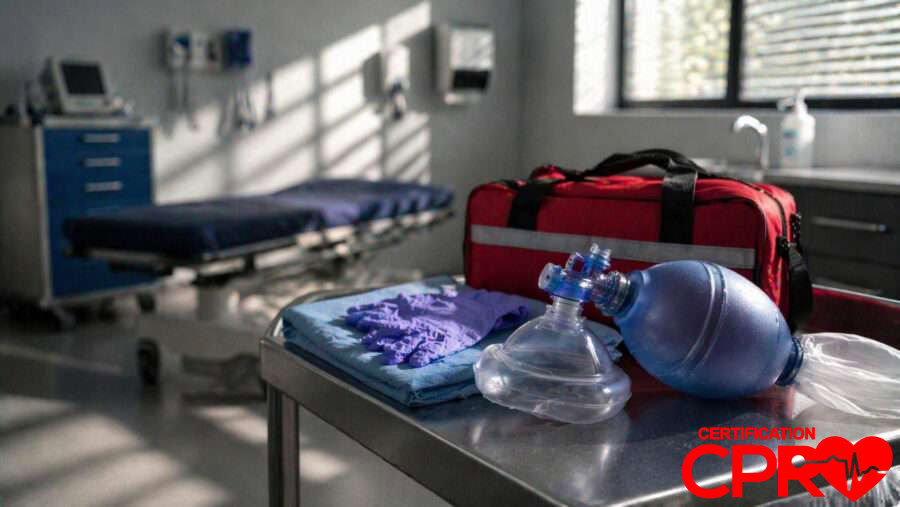
Bag-mask ventilation is another distinguishing element. Rather than mouth-to-mouth rescue breathing, healthcare providers use bag-mask devices (BVM) to deliver ventilations. BLS training includes how to achieve and maintain a mask seal, how to deliver appropriate ventilation volumes, and how to coordinate ventilations with compressions in both single and two-rescuer scenarios. This is a hands-on skill that requires practice, the seal technique is non-obvious, and doing it wrong produces poor results.
BLS also covers pediatric and infant resuscitation with the clinical depth appropriate for providers who may encounter arrests across age groups in their work, as well as the recognition of life-threatening respiratory emergencies and choking in adults and children.
How BLS Differs from Layperson CPR
The most important practical difference is who the course is designed for and what it assumes about the setting. A general public CPR class assumes a bystander responding to an unexpected emergency, using their hands and a phone to call 911. BLS assumes a responder who may be part of a healthcare system, may be working with equipment, will likely be responding as part of a team, and may need to match the course name requested by an employer, school, or clinical program.
The clinical content is more technical, the scenarios more complex, and the skills higher-level. BLS providers are expected to manage the airway with equipment, not just their hands. They’re expected to work within resuscitation team protocols, not just react independently. The course reflects the reality that in a hospital or clinical setting, a person going into cardiac arrest will have multiple trained responders within minutes, and coordinating those responders is as important as any individual technique.
A general CPR card should not be treated as a substitute when the paperwork asks for BLS. A nurse, dental worker, medical assistant, or clinical student should match the course name before booking because BLS includes clinical skills that a minimal public CPR course may not cover.
Who Needs BLS Certification
Healthcare providers and students often use BLS because it matches the hands-on CPR, AED, ventilation, and team-response skills expected in clinical settings. Nurses, medical assistants, dental workers, EMTs, respiratory therapists, therapy students, and clinical-rotation students should confirm the exact card name with the person checking their paperwork.
Healthcare students often need a current CPR card before clinical placements begin. Nursing programs, physician assistant programs, dental programs, and allied-health programs may name AHA BLS directly. If the instructions are unclear, ask the program before registering.
Non-clinical staff in healthcare facilities sometimes need BLS as well, depending on their role and facility policy. Security personnel, administrative staff who may be first to respond in certain areas, and other ancillary healthcare employees should confirm whether their employer expects current BLS certification even if the role is not strictly clinical.
BLS Course Format and Renewal
AHA BLS courses cover both the knowledge and skills components. Some AHA training centers offer blended learning, with an online knowledge module completed before a shorter in-person skills session. Before choosing that format, confirm the expected format with your employer or program; some healthcare systems prefer the full in-person BLS course even when blended options exist.
BLS certification is valid for two years. Renewal still follows the current AHA BLS course path and includes skills practice and evaluation. At CPR Certification Atlanta, renewal students take the same full BLS class length as initial students, so plan for the full training block. Many healthcare employers track provider certification expiration dates and schedule renewals proactively; in others, the individual provider needs to monitor the expiration date and renew before it lapses.
The skills tested in BLS renewal include compressions, ventilations with a bag-mask, two-rescuer coordination, AED use, and infant/child CPR. Providers who practice these skills regularly often find renewal less intimidating because the movements are familiar. The primary value of the renewal, beyond keeping the card current, is familiarization with any guideline updates that have occurred since the prior certification period.
High-Quality CPR in Clinical Settings
BLS places significant emphasis on what the AHA calls high-quality CPR, compressions at the correct rate (100-120 per minute), the correct depth (at least two inches for adults), with complete chest recoil between compressions, minimal interruptions, and avoidance of excessive ventilation. These aren’t arbitrary standards. Research consistently shows that deviation from each of these parameters produces measurable reductions in blood flow and survival rates.
Upcoming CPR Class Dates and Times
In clinical settings, high-quality CPR is harder to maintain than it sounds. Fatigue sets in faster than most people expect, compressor quality degrades significantly after two minutes of continuous compressions. BLS training emphasizes the rotation protocol: switching compressors every two minutes during rhythm checks, announcing the switch plainly, and minimizing the interruption. These are coordination skills that don’t exist in single-rescuer layperson CPR but are foundational to the team-based resuscitation that clinical settings require.
For healthcare providers, BLS isn’t just a credential box to check, it’s the foundation of resuscitation response that every other advanced intervention builds on. ACLS, PALS, and ATLS training all assume BLS competency as the starting point. Providers who take BLS seriously, practice the techniques between certification cycles, and understand the reasoning behind each standard perform better when resuscitation counts.